
Nasscom Advanced DS Program with AI & ML

Immersive Learning Program

The NASSCOM Advanced Data Science Program with AI & ML by Emerging India Analytics is a comprehensive, Industry-recognized certification program designed to empower learners with cutting-edge knowledge in Artificial Intelligence, Machine Learning, and Data Science. With a blend of theoretical concepts, practical tools, and hands-on project work, this program is aligned with current industry demands. It is ideal for aspiring Data Scientists, AI/ML professionals, and fresh graduates seeking to enter the booming field of data-driven innovation. The course is structured to ensure learners can solve real-world problems using data and advanced algorithms while building a solid foundation in analytics, AI, and decision-making.

OUR KNOWLEDGE PARTNERS

Introduction

Advanced Data Science Program With AI & ML

This 145-hours intensive training program NASSCOM Advanced Data Science Program with AI & ML is designed to provide a structured, step-by-step learning experience in key areas of data science, including Python programming, Statistics, Machine Learning, Deep Learning, Computer Vision, NLP, Reinforcement Learning, SQL, and Business Intelligence tools such as Tableau and Power BI.
Each subject is thoughtfully divided into manageable daily modules to ensure strong conceptual understanding and steady progress. The curriculum is hands-on, with a focus on real-world application through a series of mini and major projects.
By the end of the program, participants will have developed AI models, conducted predictive analytics, and created impactful data visualizations using industry-standard tools, equipping them with the skills needed to excel in top data science roles.

Data Science & AI Training

Tools

Python
SQL
Scikit-learn
Tensorflow
Keras
NLP
OpenCV
BERT
NumPy
Pandas
Matplotlib
Seaborn
Tableau
PowerBI

Program Structure

40-Hours Pre-Learning Module

Before you embark on the live academic session, get ready for the Program. You will get a series of online recorded tutorials to understand the structure of AI & ML to know about the fundamentals, which would enrich your future learning experience.

145-Hours Live Instructor-Led Training:

You will get an execution-based learning experience on Python, Statistics, Machine Learning, Deep Learning, Computer Vision, Natural Language Processing, Reinforcement Learning, TensorFlow, Keras, NLTK, OpenCV, BERT.

Access to Recorded Live Videos

Learning does not stop here. To support better understanding of concepts and skill mastery, recorded videos of live classes will be provided to learners. These videos will be accessible for up to 6 months after course completion.

Domain-specific Projects & Assignments

To master the skills acquired during the course, learners are required to complete and submit few projects within one month of course completion. For guidance, they can reach out to expert trainers during this period.
Curriculum

LEARN WITH A WORLD CLASS CURRICULUM

Module 1. Course Introduction
Day 01: Introduction to Artificial Intelligence & Machine Learning
  • Introduction to AI and Machine Learning
  • History and evolution of AI
  • Types of machine learning
  • Applications and industry use cases
Module 2. Python For Data Science
Day 02: Introduction to Python, Why Python, Variables, Operators, Strings, Indexing
  • Python fundamentals
  • Variables and data types
  • Basic operators
  • String manipulation and indexing
Day 03: Data Structures, Functions, Creating Function, Calling a function, Function Parameter
  • Lists, dictionaries, tuples, and sets
  • Function definition and calling
  • Function parameters and return values
  • Function scope
Day 04: Lambda Function, Conditional Statement, Loops and it's Control Statement
  • Lambda functions
  • Conditional statements (if, elif, else)
  • Loops (for, while)
  • Loop control statements (break, continue, pass)
Day 05: NumPy, Pandas for Data Handling
  • NumPy arrays and operations
  • Pandas DataFrames and Series
  • Data manipulation with Pandas
  • Data cleaning and preprocessing
Day 06: Matplotlib, Seaborn for Data Visualization
  • Basic plotting with Matplotlib
  • Advanced visualizations with Seaborn
  • Customizing plots
  • Creating interactive visualizations
Module 3. Statistics For Data Science
Day 07: Introduction to Statistics, Descriptive Statistics, Sample, Population, Major of Central Tendency
  • Fundamentals of statistics
  • Descriptive statistics
  • Population vs. sample
  • Measures of central tendency (mean, median, mode)
Day 08: Standard Deviation, Variance, Range, IQR, Outliers, Correlation, Covariance Skewness, Kurtosis
  • Measures of dispersion
  • Interquartile range and outlier detection
  • Correlation and covariance
  • Distribution characteristics (skewness, kurtosis)
Day 09: Probability, Probability distributions, Central Limit Theorem, Binomial & Normal Distribution
  • Basic probability concepts
  • Common probability distributions
  • Central Limit Theorem
  • Binomial and normal distributions
Day 10: Type I & Type II Error, T-test, Z-test, Hypothesis Testing
  • Hypothesis testing fundamentals
  • Type I and Type II errors
  • T-tests and z-tests
  • Practical applications of hypothesis testing
Module 4. Mini Project
Day 11: Data Analysis & Visualization
  • Exploratory data analysis
  • Data visualization techniques
  • Insight extraction from data
  • Mini project implementation
Module 5. Machine Learning
Day 12: Introduction to ML, Types of variables, Encoding, Normalization, Standardization
  • Machine learning fundamentals
  • Feature types and encoding techniques
  • Data normalization and standardization
  • Preparing data for ML algorithms
Day 13: Linear Regression, Logistic Regression, SVM, KNN
  • Linear regression models
  • Logistic regression for classification
  • Support Vector Machines
  • K-Nearest Neighbors algorithm
Day 14: Naïve Bayes, Decision Tree, Random Forest, MSE, RMSE
  • Naïve Bayes classifiers
  • Decision trees
  • Random Forest ensemble method
  • Regression metrics (MSE, RMSE)
Day 15: R2 Score, F1-Score, Confusion Matrix, Classification Report, Accuracy
  • Regression evaluation metrics
  • Classification evaluation metrics
  • Confusion matrix analysis
  • Model performance assessment
Day 16: Ensemble Techniques, Xgboost, Unsupervised Machine Learning-Introduction
  • Ensemble learning techniques
  • Gradient boosting with XGBoost
  • Unsupervised learning concepts
  • Applications of unsupervised learning
Day 17: PCA, Clustering, k-Means Clustering and Hierarchical clustering
  • Principal Component Analysis
  • Clustering fundamentals
  • K-means clustering
  • Hierarchical clustering
Module 6. Deep Learning
Day 18: Introduction to Neural Network, Forward Propagation, Activation Function (Linear, Sigmoid)
  • Neural network fundamentals
  • Forward propagation process
  • Linear activation function
  • Sigmoid activation function
Day 19: Activation Function (Relu, Leaky Relu), Optimizers, GD, Stochastics Gradient Descent
  • ReLU and Leaky ReLU activation functions
  • Optimization algorithms
  • Gradient Descent
  • Stochastic Gradient Descent
Day 20: Mini batch Gradient Descent, Adagrad, Padding, Pooling, Convolution
  • Mini-batch gradient descent
  • Adaptive gradient algorithm (Adagrad)
  • Convolutional neural networks concepts
  • Padding and pooling operations
Day 21: Checkpoints and Neural Networks Implementation
  • Model checkpointing
  • Practical neural network implementation
  • Deep learning frameworks
  • Training and evaluation processes
Day 22: Time Series Analysis-Introduction, Various components of the TSA
  • Time series concepts
  • Time series components (trend, seasonality, residuals)
  • Time series visualization
  • Stationarity and tests
Day 23: Decomposition Method(Additive and Multiplicative), ARMA, ARIMA
  • Time series decomposition methods
  • Autoregressive Moving Average (ARMA) models
  • Autoregressive Integrated Moving Average (ARIMA) models
  • Forecasting techniques
Module 7. Computer Vision
Day 24: Introduction to Image Processing, and OpenCV
  • Fundamentals of image processing
  • Introduction to OpenCV library
  • Image manipulation techniques
  • Basic image operations
Day 25: Feature Detection - Object Detection and Segmentation
  • Feature detection methods
  • Object detection fundamentals
  • Image segmentation techniques
  • Feature extraction and analysis
Day 26: Forward Propagation & Backward Propagation for CNN
  • Convolutional Neural Network basics
  • Forward propagation in CNN
  • Backpropagation for CNN
  • Optimizing CNN models
Day 27: CNN Architectures like AlexNet, VGGNet, InceptionNet, ResNet,Transfer Learning
  • Popular CNN architectures
  • AlexNet, VGGNet model design
  • InceptionNet and ResNet principles
  • Transfer learning for computer vision
Module 8. Natural Language Processing (NLP)
Day 28: Introduction to NLP, Introduction to Text Mining, & Applications
  • NLP fundamentals
  • Text mining concepts
  • Applications of NLP
  • NLP libraries and tools
Day 29: Text Processing using Python, Text Segmentation & Sentiment Analysis
  • Text preprocessing techniques
  • Tokenization and segmentation
  • Sentiment analysis methods
  • Python libraries for text processing
Day 30: Introduction to Topic Modeling, LDA, Name-Entity Recognition (NER)
  • Topic modeling concepts
  • Latent Dirichlet Allocation (LDA)
  • Named Entity Recognition
  • Applications of topic modeling and NER
Day 31: Understanding Transformers, BERT Introduction & its architecture, Text classification
  • Transformer architecture
  • BERT model fundamentals
  • Attention mechanisms
  • Text classification with transformers
Day 32: Advanced Text Mining/Keyword Extraction, TF-IDF, Word2Vec usage), Text Classification, Automatic Speech Recognition
  • Advanced keyword extraction techniques
  • TF-IDF and Word2Vec models
  • Text classification methods
  • Introduction to speech recognition
Module 9. Reinforcement Learning (RL)
Day 33: RL Framework, Component of RL Framework, Examples of Systems
  • Reinforcement learning fundamentals
  • Components of RL systems
  • Reward systems and state spaces
  • Real-world applications of RL
Day 34: Types of RL Systems, Q-Learning
  • Model-based vs. model-free RL
  • Value-based vs. policy-based RL
  • Q-learning algorithm
  • Implementing Q-learning
Module 10. Major Project
Day 35: Machine Learning, Deep Learning & NLP - based Predictive Modeling
  • Integrated ML, DL, and NLP approaches
  • End-to-end predictive modeling
  • Advanced model architecture design
  • Model deployment and scalability
Module 11. SQL
Day 36: Basic of Database & its Types, Data Types, Operators, Create and Insert
  • Database fundamentals
  • SQL data types
  • SQL operators
  • CREATE and INSERT statements
Day 37: Drop, Truncate, Delete, Alter, Update, Select, Range, Operator, In,Wildcard
  • Data manipulation commands
  • Data definition language (DDL)
  • SELECT statements and filtering
  • Wildcard operators
Day 38: Like, Clause, Constraint, Aggregation Function, Group by, Order by
  • LIKE operator and pattern matching
  • SQL constraints
  • Aggregation functions (SUM, AVG, COUNT, etc.)
  • GROUP BY and ORDER BY clauses
Day 39: Having, Joins, Case, Complex Queries, Doubt Clearing
  • HAVING clause
  • SQL JOINs (INNER, LEFT, RIGHT, FULL)
  • CASE statements
  • Advanced SQL queries
Module 12. Tableau
Day 40: Tableau Desktop, Tableau products
  • Tableau Desktop introduction
  • Tableau product ecosystem
  • Tableau interface navigation
  • Connecting to data sources
Day 41: Data import, Measures, Filters
  • Data importing techniques
  • Dimensions and measures
  • Filter types and applications
  • Data preparation in Tableau
Day 42: Data transformation, Marks, Dual Axis
  • Data transformation options
  • Using marks in visualizations
  • Dual axis charts
  • Advanced visualization techniques
Day 43: Manage worksheets, Data visualization, Dashboards
  • Worksheet management
  • Creating effective visualizations
  • Dashboard design principles
  • Interactive dashboard creation
Module 13. Power BI
Day 44: Power BI Platform, Process Flow
  • Power BI ecosystem
  • Power BI Desktop interface
  • Data workflow in Power BI
  • Connecting to data sources
Day 45: Features, Dataset, and Bias
  • Power BI key features
  • Dataset creation and management
  • Understanding data bias
  • Data preparation techniques
Day 46: Pivoting, Query Group, DAX Function
  • Data pivoting operations
  • Query organization
  • DAX function fundamentals
  • Creating calculated measures
Day 47: Formula, Charts, Reports and Dashboards
  • DAX formulas and expressions
  • Chart types and selection
  • Report creation best practices
  • Dashboard design and deployment
Module 14. Major Project
Day 48: Database to Dashboard: Project Implementation with SQL, Tableau & Power BI
  • End-to-end business intelligence project
  • Database design and implementation
  • Data visualization with Tableau and Power BI
  • Creating interactive business dashboards

Skills You Will Possess

Data Manipulation
Data Wrangling
Data Cleaning
Data Visualization
Statistical Analysis
Data Analysis
Descriptive Analytics
Machine Learning
Predictive Analytics
Text Processing
Image Processing
Sentiment Analysis

Program Benefits

Cutting Edge Curriculum

Hand crafted Course content made by Experts from various Industries. Learn through Practical case studies and multiple projects.

On the Go Learning

Online accessible E-learning Material, live interactive lectures, Industrial Graded Projects, Case Studies and Multiple Tests & Evaluations.

Build Solid Foundation

145 hours of live instructor-led lectures covering the most in-demand tools in Data Science with Artificial Intelligence & Machine Learning.

Industry Mentorship

Receive one-on-one guidance from industry experts and confidently begin your career in the field of Data Science with AI & ML.

Recognized Certification

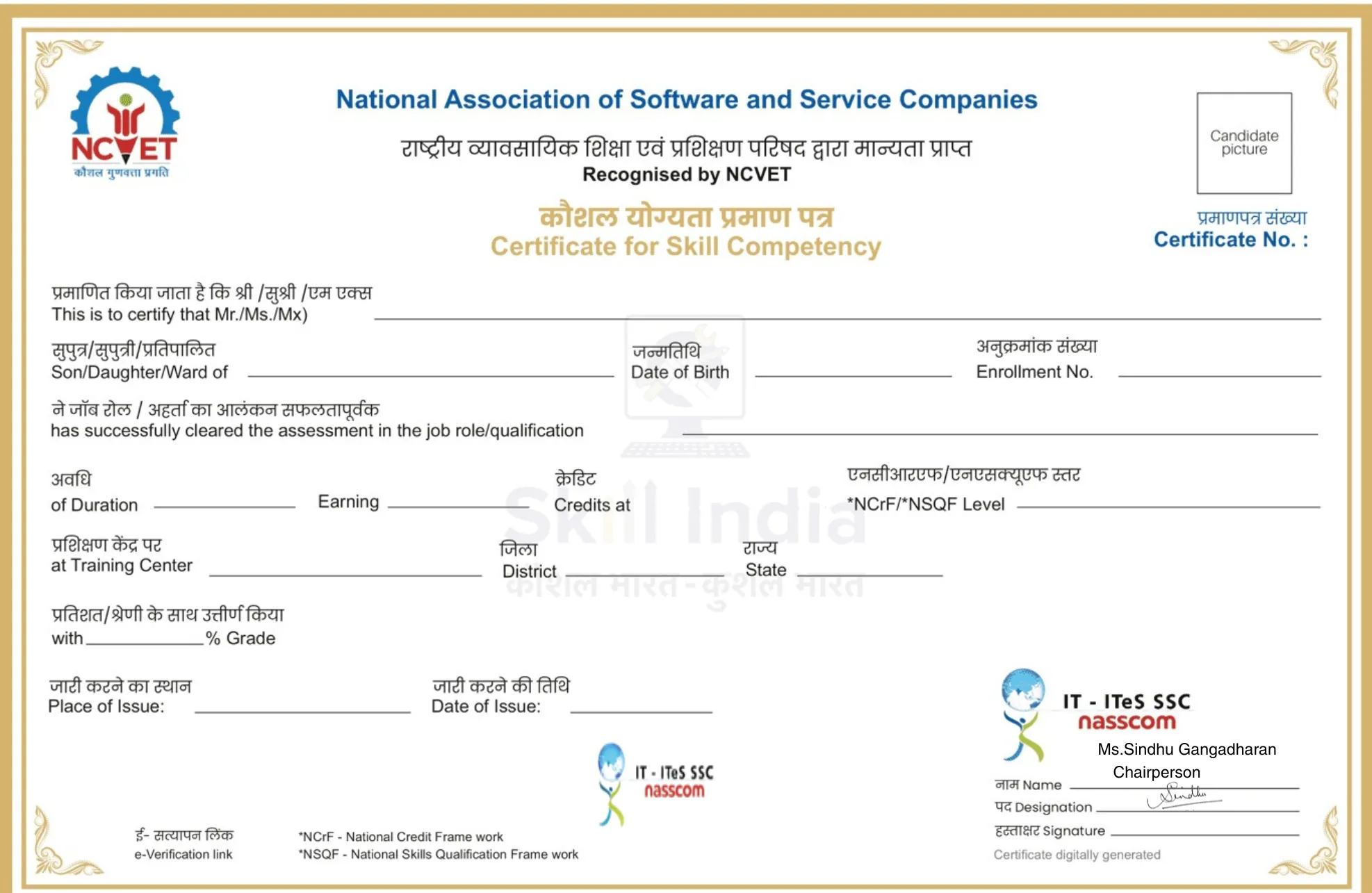
Earn a Government of India approved & globally recognized certificate by NASSCOM IT- ITes SSC by clearing assessment Exam.

Industry Certificate

Opportunity to earn Highest Industry Certificate of Machine Learning Engineer (NSQF LEVEL 5) from SSC NASSCOM.

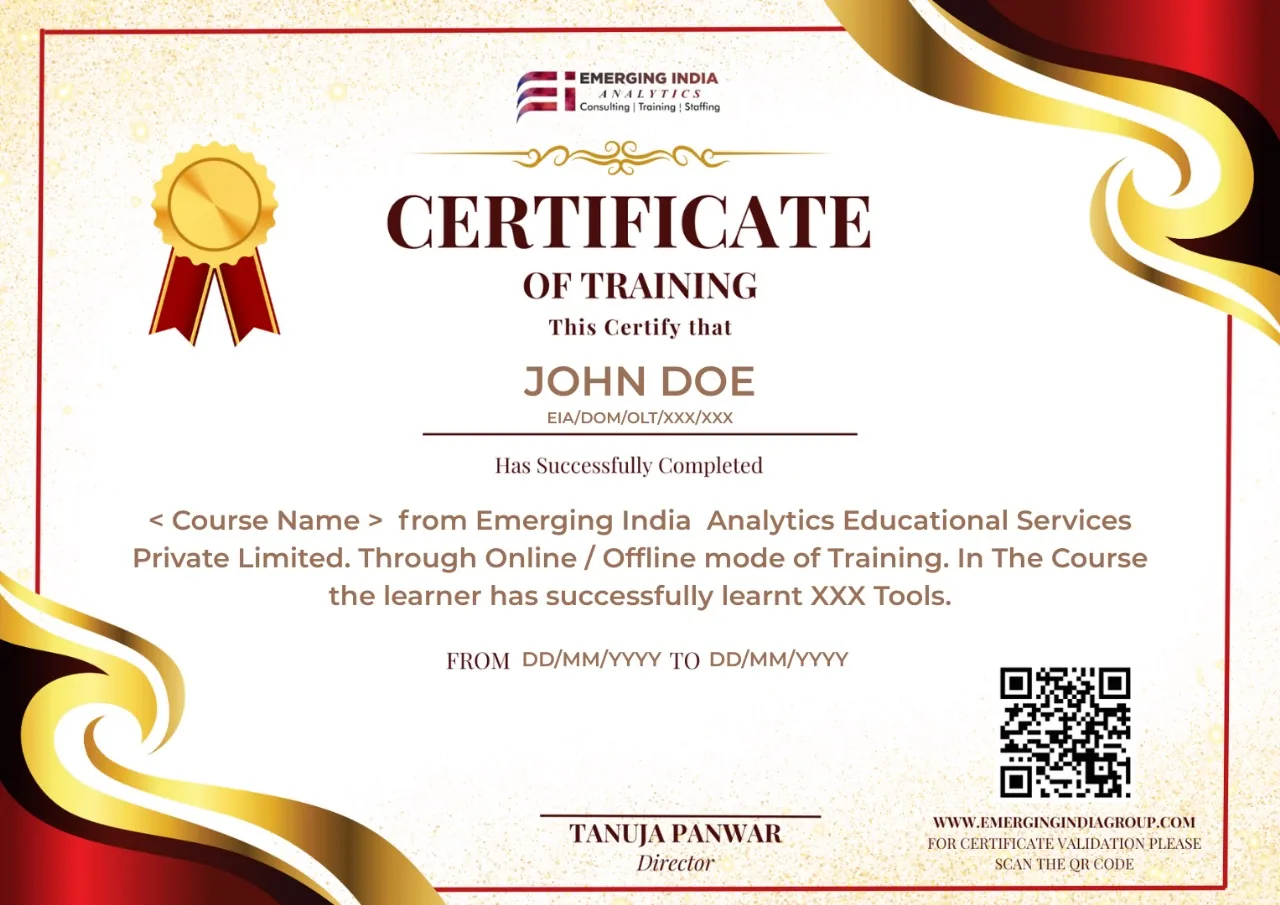
Course Certificates

Upon successful completion of the program and passing the final assessment, you will receive:

  • Course Completion Certificate from Emerging India Analytics
  • NASSCOM IT-ITeS Sector Skill Council Certification
  • Opportunity to earn Machine Learning Engineer (NSQF LEVEL 5) certification from SSC NASSCOM

These certifications are recognized by employers globally and validate your expertise in Data Science and AI.

Sample Certificate
Sample Certificate

Real World Projects

Projects will be a part of your Advanced Post Graduate Certification in Data Science & Artificial Intelligence to solidify your learning. They ensure you have real-world experience in Data Science and AI.

Practice 20+ Essential Tools

Designed by Industry Experts

Get Real-world Experience

Beginner

Real Estate Analytics

Real Estate Analytics will involve supervised learning with an ensemble of various regression algorithms where we will optimize the predictions based on the error rate.

Intermediate

Solar Power Efficiency

The project will encompass three target variables that we will predict using the supervised machine learning algorithms for regression problems and minimize the error by tuning the hyperparameters.

Advanced

Recommendation Engine

In the Recommendation Engine project, we will use singular value decomposition to draw out relevant recommendations for music and movie selections based on the historical data points.

Career Services By emergingindiagroup

Soft Skills

Learners will be closely mentored to develop key soft skills like communication, teamwork, and adaptability, enhancing their career path.

Interview Preparation

Participate in mock interviews and receive detailed feedback sessions with experienced industry experts.

Profile Building

Attend resume workshops and get your LinkedIn profile optimized for better professional visibility.

Placement Assistance

Placement opportunities become available upon clearing the Placement Readiness Test and meeting eligibility criteria.

Exclusive access

Get exclusive access to our dedicated job portal to apply for open positions. Partnering with a select few start-ups and product companies, we offer personalized mentorship and support to help you explore relevant job opportunities and advance your career.

Real World Projects

Projects will be a part of your Nasscom Advanced Data Science Program with AI & ML to solidify your learning. They ensure you have real-world experience in Data Science, AI & ML.

  • Practice 20+ Essential Tools
  • Designed by Industry Experts
  • Get Real-world Experience

Our Alumni Works At

Learners thought about us

"
It was a great experience with Emerging India Analytics. The course format and content was very good. The faculty, Ms Lakshmi is very knowledgeable. She know the subject very well and the way she conducted the sessions was very much satisfactory. Thank you so much for your services and wish you all the best. God Bless.
Yogesh Ranjan Ghavnalkar

Yogesh Ranjan Ghavnalkar

Learner

"
As a non-IT background student, I am very much satisfied with the live sessions/classes conducted by Emerging India Analytics. Special thanks to the instructor/trainer, the way he is teaching, from the basic fundamentals, that a student having zero knowledge in IT/CS & coding, can easily understand the subjects/topics.
Tushar Kanta Behera

Tushar Kanta Behera

Learner

"
Classes are progressing smoothly, doubts are consistently addressed, fostering a clear understanding. Positive atmosphere, engaged learning, and effective communication contribute to a successful academic experience.
Aadi Bhardwaj

Aadi Bhardwaj

Learner

"
Coming from non-IT background was initially worrisome but I took the bold step into this course. The tutors have been fantastic as well as the personal support team. Looking back at the journey so far, I will say it's worth the all-round commitment and I recommend this program without reservation.
Israel Samuel

Israel Samuel

Learner

Admission Details

The application process consists of three simple steps. An offer of admission will be made to selected candidates based on the feedback from the interview panel. The selected candidates will be notified over email and phone, and they can block their seats through the payment of the admission fee.

1

Submit Application

Tell us a bit about yourself and why you want to join this program

2

Application Review

An admission panel will shortlist candidates based on their application

3

Admission

Selected candidates will be notified within 1week.

Program Fees

Our Loan Partners

Loan Partner 1 Loan Partner 2 Loan Partner 3

Zero Cost EMI options Available

from RBI Approved NBFCs

Starting from
₹4,999*
Contact Us for more details

Others Payment Options

We provide the following options for one-time payment.

Internet Banking

Credit / Debit Card

Total Admission Fees
₹50,000*
Apply Now

FAQs

1. What is the duration of the Nasscom Advanced DS Program with AI & ML?
The Nasscom Advanced DS Program with AI & ML is a comprehensive 06-month course designed to cover a wide spectrum of Artificial Intelligence & Machine Learning concepts and tools.
2. What topics are covered in the course?
The course covers a wide range of topics including Python, Statistics, SQL, Tableau, Power BI, Machine Learning, Deep Learning, Computer Vision, Natural Language Processing, and Reinforcement Learning.
3. Do I need any prior knowledge to enroll in this course?
No prior knowledge is required. The course is designed for both beginners and professionals, starting with foundational concepts and gradually progressing to advanced topics.
4. How are the classes conducted?
Classes are conducted through live interactive sessions led by experienced instructors. Recorded sessions are also provided for flexible learning and future reference.
5. Are there any hands-on projects included in the course?
Yes, the course includes real-world projects designed to ensure practical learning. These hands-on projects help reinforce your understanding and build industry-relevant experience.
6. Will I receive a certificate upon completion?
Yes, upon successful completion of the course and clearing the online exam, you will receive a NASSCOM certification, which is highly recognized across the industry.
7. What kind of support is available if I have questions or need help?
You’ll have access to dedicated doubt-clearing sessions, project-based classes, and a responsive support team to assist you with any queries or technical issues throughout the course.
8. Will I receive a certificate upon completion?
Yes, upon successful completion of the course and clearing the online exam, you will receive a NASSCOM certification, which is highly recognized across the industry.
9. Can I try a demo class before enrolling?
Yes, you can request a demo class to experience the teaching methodology and course structure before making a decision.
10. What if I miss a live class?
Don’t worry—every live session is recorded and made available to you, so you can review it at your convenience and stay on track.